Solutions › Plan and Budget ›
Capital Planning and Budgeting
CIPAce Solution · Plan and Budget

Capital Program Planning and Budgeting for Government

Build comprehensive, optimized multi-year capital improvement plans, from project intake and evaluation to prioritization and funding strategy, to budget development and approvals, and to implementation readiness.

Also Known As
CIP · Capital Improvement Plan · Capital Improvement Program · Capital Budgeting Software
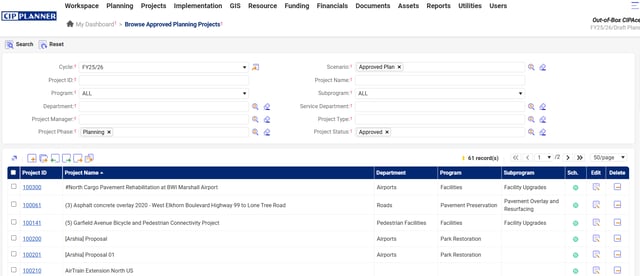
CIPAce capital plan and funding scenario view
$250B+
in capital programs across all CIPAce customers
20,000+
users across all CIPAce customers
25 years
of CIPPlanner capital infrastructure delivery
The Challenge

Five Risks of Planning Capital in Spreadsheets

Capital planning is a high-stakes, multi-year decision process shaped by uncertainties, from shifting funding to evolving organizational priorities driven by unpredictable future events. Most organizations manage it in spreadsheets and disconnected systems, which exposes them to avoidable risk.

Inconsistent Assumptions With Limited Auditability

Cost, escalation, and revenue assumptions live in different copies of different workbooks. Two analysts reach two answers, and neither answer can be traced back to what it was built on.

Slow, Cumbersome Scenario and What-If Analysis

Modeling one alternative takes days, so only one or two ever get modeled. The plan that goes to the council is the plan somebody had time to build, not the best one available.

Weak Alignment Between Projects and Available Funding

The ranked list and the money are maintained separately, so the priority order and the funding reality only meet at the end, when there is no time left to reconcile them.

Fragmented Approval Process With Low Visibility

Reviews happen in email across departments and external stakeholders. Nobody can say what is waiting on whom, and accountability for a decision is hard to reconstruct afterwards.

Manual and Time Consuming Reporting

Every internal update, grant report, and public disclosure becomes a fresh data pull, because the information sits in systems that were never designed to answer the question.

Platform Architecture

Built on the CIPAce™ Enterprise Platform

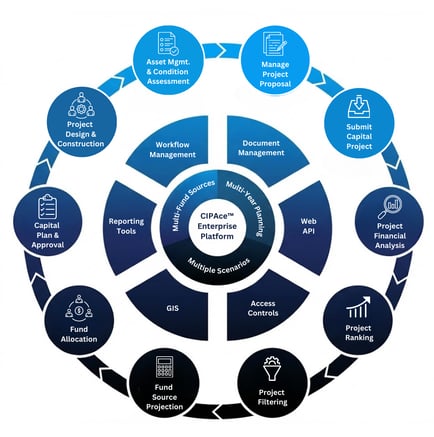
CIPAce Capital Planning and Budgeting architecture, with project intake, ranking, funding, budgeting, reporting, and approval capabilities arranged around a central CIPAce Enterprise Platform core for multi-fund, multi-year, multi-scenario planning

Benefits at a Glance

  • Project intake, ranking, and prioritization on one record
  • Multi-year, multi-fund, and multi-scenario capital planning
  • Funding strategy from source projection through allocation
  • Budget development and approval workflows with a full audit trail
  • Financial analysis and reporting for leadership and the public
The Planning Cycle

From Project Intake to Implementation Readiness

CIPAce™ provides a centralized environment to manage projects, funding, and feasibility impacts dynamically across multiple planning cycles. Select a stage to see what happens in it.

Proposal Intake

Proposals arrive from all stakeholders and are tracked in real time. Predefined screening criteria and process automation apply before anything reaches an evaluator, so the queue that gets reviewed is already a real queue.

Scoping, Cost Estimate, and Impact

Project Scoping develops the scope and the cost estimate that everything downstream depends on. Project Impact Analysis supports both quantitative and non-quantitative assessment, so a candidate can be judged on more than its cost.

Ranking and Filtering

Project Ranking runs multi-scenario analysis against agency specific criteria and a pre-defined score or formula. Filtering separates funded from unfunded needs using structured approaches across scenarios, so the comparison holds at portfolio level and at project level.

Projection, Modeling, Allocation, Budget

Funding Projection develops and maintains a multi-year revenue stream against user defined assumptions and funding sources. Financial Modeling applies user selected models for cost and cash flow projections. Fund Allocation assesses full or partial funding across projects under various scenarios, and Capital Budget creates and manages budget records throughout their lifecycle.

Review, Approval, and Readiness

Capital Plan Review and Approval enables progressive review and approval by all stakeholders through agency defined workflow and participants. Project Readiness tracks funded and unfunded projects alike, and promotes a project from planning to implementation once funding is authorized.

Prioritization is a funding problem. A ranked list that cannot see the money produces an order nobody can act on. Because ranking, funding projection, and the capital budget read the same record in CIPAce, changing a score changes what is fundable in the same pass.

Core Configurable Planning Tools

Financial Modeling and Projections

Best-practice based modeling for upfront capital budgeting analysis and ongoing cash flow projections.

Flexible Planning Horizons

Planning horizons are easily set to accommodate agency specific or project specific needs.

Spending Curve

Preconfigured or user defined, supporting the distribution of costs across multiple fiscal years.

Multiple Scenario Analysis

From portfolio level down to individual projects, so alternatives can be compared rather than argued.

Real-Time Lifecycle Record Tracking

Comprehensive record tracking and management for the entire lifecycle, from initiation and authorization through to retirement.

Solution Core Capabilities

Ten Capabilities on One Record

CIPAce™ Capital Planning and Budgeting offers full-spectrum capabilities, tailored to each customer’s business processes and implemented through versatile configurations, workflows, automation, and integrations with third party systems as needed.

Proposal Intake

From all stakeholders with real-time tracking as well as predefined screening criteria and process automation.

Project Scoping

For developing project scope and cost estimates, and for their subsequent evaluation.

Project Ranking

Offers user-friendly and multi-scenario analysis per agency-specific criteria and pre-defined score or formula.

Funding Projection

To develop and maintain multi-year revenue stream per user defined assumptions and funding sources.

Financial Modeling

To apply user selected financial models for cost and cash flow projections.

Fund Allocation

To assess full or partial funding options across projects under various scenarios as needed.

Capital Budget

To create and manage budget records throughout their lifecycle.

Project Impact Analysis

Supports both quantitative and non-quantitative impact analyses.

Capital Plan Review and Approval

Enables progressive and seamless review and approval by all stakeholders via agency-defined workflow and participants.

Project Readiness

Supports tracking and managing both funded and unfunded projects, and promotes projects from planning to implementation once funding is authorized.

What You Can Achieve

A Planning Process That Repeats, and a Record That Holds Up

Standardized and Streamlined Capital Planning

  • Streamline project nomination and evaluation by encouraging broad participation
  • Consistent and repeatable planning cycles and scenario analysis with minimum effort and time
  • Centralized records keeping with increased data integrity and 24/7 web access
  • Enhanced and convenient cross-department collaboration with accountability and transparency
  • Automatic and workflow-driven review and approval processes
  • Seamless and consistent processes for the evaluation, ranking, and prioritization of all project and funding options
  • Maintain an audit-ready record of assumptions, approvals, and changes
  • Publish dashboards and reports that improve transparency for leadership and stakeholders

Align and Access Projects, Funding, and Budgets Anywhere

  • Track funded vs. unfunded needs using structured filtering approaches across scenarios
  • Generate budgets from approved plans and manage changes through standardized and controlled processes
Overview

See Capital Planning and Budgeting in CIPAce

A short walkthrough of proposal intake, scenario ranking, funding projection, and the capital budget.

Built on CIPAce

Configurable Without Source-Code Changes

CIPAce™ is a cloud-based, metadata driven, low-code, enterprise-grade platform organically developed and exclusively deployed by CIPPlanner Corporation. It is designed to adapt without requiring source-code changes for many common enhancements.

Dashboards and Portals

Configurable dashboards consolidate tasks, data, and drill-down insights, including health check style visual indicators for performance measures.

Reporting and Analytics

Access virtually any data element for standard, custom, and analytic reporting, with outputs including PDF, Word, and Excel.

Workflow and Notifications

Automate multi-party review and approval with routing, validation rules, workflow logs, and email or dashboard notifications.

Document Management

Centralize records across planning and budgeting with version control, routing for review and approval, full-text search, and online mark-up including CAD.

Audit Trail and Access Control

Track changes to business records, who made them, and when, supporting accountability, compliance, and audit readiness.

Integration Framework and APIs

Two-way integrations with third-party software through the CIPAce Web API, supporting enterprise integration across financial systems, GIS, and other tools.

Mobile Enablement

A mobile application supports field and on-the-go productivity, including use cases with limited connectivity.

24 U.S. states

with city, county, state, utility, and transportation agencies running CIPAce™

More than 90%

of CIPPlanner customers are public sector organizations

100% dedicated

to capital infrastructure enterprise software development and system deployment

Deployment Options

CIPAce™ supports both traditional On Premises deployments and Software-as-a-Service deployment models, depending on your organization’s IT strategy and governance requirements.

Ideal For

  • Capital planning and CIP teams
  • Finance, budget, and forecasting groups
  • Public works, transportation, utilities, and facilities departments
  • Leadership teams seeking optimal and automated processes
Questions Buyers Ask

Capital Planning and Budgeting Software, Answered

The questions below are the ones agencies and evaluation committees ask most often when they start looking. Each answer gives the criteria first, then what CIPAce™ does about them.

Integration is a platform question rather than a feature checkbox. Ask any vendor three things: whether the integration is two way or export only, whether it is configured or custom coded, and what happens to it at the next upgrade.

CIPAce™ includes an Integration Framework and the CIPAce Web API, which enable two-way integrations with third-party software and support enterprise integration strategies across financial systems, GIS, and other tools. Because the platform is metadata driven and low-code, many common enhancements are made without source-code changes, so an integration does not become a fork that has to be rebuilt at every release.

No single product is best for every public works department, so the useful question is what separates them. Five criteria decide most evaluations:

  • Does it hold the whole cycle, from project intake through prioritization, funding strategy, budget approval, and implementation readiness, or only one slice of it
  • Can it run multi-scenario what-if analysis at portfolio level and at individual project level
  • Does every assumption, approval, and change carry a user and a timestamp, so the plan survives an audit
  • Does it integrate two ways with the financial system and the GIS you already run
  • Is it configured to your process, or does your process have to change to match the software

CIPAce™ Capital Planning and Budgeting is built against all five. It is used by public works, transportation, utilities, and facilities departments, by capital planning and CIP teams, and by finance, budget, and forecasting groups.

CIPAce™ does both against the same record, which matters more than doing either one well in isolation. Prioritization that cannot see the money produces a ranked list nobody can fund.

Project Ranking runs multi-scenario analysis against agency-specific criteria and a pre-defined score or formula. Fund Allocation assesses full or partial funding options across projects under various scenarios. Capital Budget creates and manages budget records throughout their lifecycle. Because the ranking and the budget read the same data, changing a score changes what is fundable in the same pass.

Multi-year is the design point for CIPAce™, not an extension bolted onto an annual budget tool. Four things make that concrete:

  • Planning horizons are flexible and easily set, to accommodate agency-specific or project-specific needs
  • A preconfigured or user-defined Spending Curve distributes costs across multiple fiscal years
  • Funding Projection develops and maintains a multi-year revenue stream against user-defined assumptions and funding sources
  • Multiple scenario analysis runs from portfolio level down to individual projects

Records are tracked comprehensively and in real time across the entire lifecycle, from initiation and authorization through to retirement.

Agencies generally use one of four kinds of tool, and each one fails in a predictable place:

  • Spreadsheets. Flexible and already paid for, but assumptions drift between copies and there is no audit trail
  • The budgeting module of an ERP. Strong on the annual operating budget, weak on multi-year capital and on scenario analysis
  • Project management tools. Useful once a project is funded, with nothing upstream of the funding decision
  • Purpose-built capital program platforms. Cover intake through implementation readiness on one record, at the cost of an implementation

CIPAce™ is in the fourth category. Its core configurable planning tools include financial modeling and projections, flexible planning horizons, spending curves, multi-scenario analysis, and real-time lifecycle record tracking.

Government capital budgeting carries requirements that commercial budgeting software is not built for. Weigh candidates on these five:

  • Fund-source traceability, because bond, grant, and fee dollars each carry their own reporting obligation
  • An audit trail that records what changed, who changed it, and when
  • Review and approval routing across departments and external stakeholders, with validation rules
  • Reporting and dashboards that hold up in front of leadership, a council, and the public
  • A deployment model your IT policy actually allows

CIPAce™ addresses each of these and supports both On Premises and Software-as-a-Service deployment, depending on your organization's IT strategy and governance requirements.

CIPAce™ is used by public agencies, transportation authorities, airports, and utilities, as well as state and local governments across 24 states, and by Fortune 500 companies. More than 90 percent of CIPPlanner customers are in the public sector, and the platform has been in service since 2005.

CIPPlanner supports and maintains more than 250 billion dollars in capital projects and programs on CIPAce™.

The work runs as a repeatable cycle rather than an annual scramble. In CIPAce™ it looks like this:

  • Proposals are submitted by all stakeholders, tracked in real time, and screened against predefined criteria
  • Each candidate is scoped, given a cost estimate, and evaluated for quantitative and non quantitative impact
  • Projects are ranked and filtered against agency-specific criteria under multiple scenarios
  • Revenue is projected across the planning horizon, financial models are applied to cost and cash flow, and funding is allocated in full or in part
  • Budgets are generated from approved plans, and changes are managed through standardized and controlled processes
  • Review and approval route to every stakeholder through agency-defined workflow
  • Funded and unfunded projects are both tracked, and a project promotes from planning to implementation once funding is authorized

Costs are distributed across fiscal years using a preconfigured or user-defined spending curve, so the plan reads correctly in year one and in year ten.

Prioritization is rarely a ranking problem on its own. It is a ranking problem under a funding constraint that keeps moving, which is why tools that rank well in isolation still produce lists nobody can act on. Five failures come up repeatedly:

  • Inconsistent assumptions with limited auditability, so two analysts reach different answers and neither can be checked
  • Slow, cumbersome scenario and what-if analysis, so only one or two options are ever modelled
  • Weak alignment between projects and available funding, so the ranked list and the money never meet until it is too late to reconcile them
  • A fragmented approval process with low visibility or accountability
  • Manual and time-consuming effort for internal and external reporting and collaboration

Capital planning is a high-stakes, multi-year decision process shaped by uncertainties, from shifting funding to evolving organizational priorities driven by unpredictable future events. Those pressures are compounded by competing needs such as service demands, public safety, and environmental or legal mandates, and by the coordination required across departments and external stakeholders.

Most organizations manage all of that in spreadsheets and disconnected systems. General-purpose software assumes a stable annual budget and a single approver, and a capital program has neither. The gap is less a feature gap than a fit gap, which is why configurability tends to decide these evaluations more than any single function does.

Related

Schedule a Demo with CIPPlanner

We will use your project types, your funding sources, and your approval chain, not a generic sandbox. Thirty minutes with someone who has implemented capital planning in an agency like yours.

Schedule a Demo

Tell us the size of your capital program and we will tailor the session to it.