Who We Serve ›
Water and Utilities
Who We Serve · Water and Utilities

Capital Planning Software for Water and Utilities

Plan capital programs around regulatory mandates, prioritize by condition and equity, and manage assets across their lifecycle. The City of Baltimore runs its water, wastewater, storm water, and solid waste planning on CIPAce™.

Also Known As
Water and Utilities · Wastewater · Stormwater · Utility Capital Planning
CIPAce capital planning view for a water utility
$250B+
in capital programs across all CIPAce customers
20,000+
users across all CIPAce customers
25 years
of CIPPlanner capital infrastructure delivery
The Challenge

What Utility Capital Programs Are Up Against

Water and wastewater programs are driven by regulatory mandates, evaluate hundreds of submissions a year, and depend on exact funding math. These are the pressures CIPAce™ is built for.

Capital Plans Driven by Regulatory Mandates

Water and wastewater programs are shaped by federal requirements and consent schedules, so prioritization has to weigh mandates alongside condition and cost.

Hundreds of Submissions, Uneven Quality

Utilities evaluate large numbers of project submissions each year, and inconsistent submission quality creates bottlenecks and resubmissions.

Funding Splits and Spending Curves by Hand

Projecting funding needs and distributing costs across a multi-year cycle by hand introduces error into the numbers a utility has to defend.

Aging Underground Assets

Pipe and treatment assets degrade out of sight, so condition data has to drive replacement rather than waiting for failure.

Solutions for Water and Utilities

From the Mandate to the Asset

The CIPAce™ solutions below map to how a utility actually works, from mandate-driven planning through delivery and into asset management.

Capital Planning and Budgeting

Prioritize infrastructure by asset condition, equity, and regulatory mandates, project funding across the cycle, and produce a defensible capital budget, as the City of Baltimore does.

Enterprise Asset Management

Manage water and wastewater assets across their lifecycle, using condition data to drive preventive maintenance and replacement planning rather than reactive repair.

Inspection and Work Management

Move field inspections straight to work orders, with mobile capture, crew routing, materials and inventory, and compliance reporting.

Capital Program Lifecycle Management

Deliver capital projects end to end, from procurement and design through construction, contract administration, and closeout, on one platform.

Proven at Scale

Trusted by Public Utilities

CIPAce™ runs large public utility capital programs, from planning through asset management.

Mandate-Driven Prioritization

Condition, equity, and regulatory mandates are weighted factors in one scoring system.

Condition to Reinvestment

Asset condition data drives preventive maintenance and long-term replacement planning.

24 U.S. states

with city, county, state, utility, and transportation agencies running CIPAce™

More than 90%

of CIPPlanner customers are public sector organizations

100% dedicated

to capital infrastructure enterprise software development and system deployment

Deployment Options

CIPAce™ supports both traditional On Premises deployments and Software-as-a-Service deployment models, depending on your organization’s IT strategy and governance requirements.

Ideal For

  • Water and wastewater utilities
  • Municipal public works departments
  • Stormwater and solid waste programs
  • Utility finance and planning teams
Questions Agencies Ask

CIPAce for Water and Utilities, Answered

The questions below are the ones water and utility teams ask most often. Each answer gives the criteria first, then what CIPAce™ does and where it is proven.

For a water utility the deciding factors are planning around regulatory mandates, prioritizing by condition and equity, and getting funding splits right across a multi-year cycle.

CIPAce™ is built for that, and the City of Baltimore Department of Public Works plans over 500 million dollars in annual capital projects for its water, wastewater, storm water, and solid waste systems on the platform.

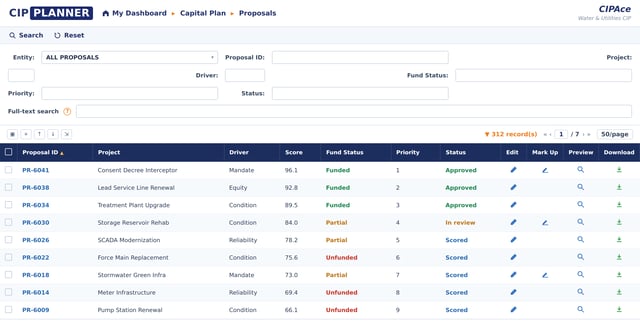
The plan has to weigh mandates alongside condition and cost, in a consistent method. CIPAce™ prioritizes infrastructure by asset condition, equity, and regulatory mandates in a weighted scoring system.

The City of Baltimore implemented the EPA mandated Integrated Planning Framework on CIPAce in just three months.

Alignment comes from making regulatory drivers an explicit, weighted factor in prioritization rather than a side note. CIPAce™ ranks projects by condition, equity, and regulatory mandates together.

Baltimore's Integrated Planning Framework, moved into an electronic weighted scoring system on CIPAce, is a working example of planning driven by federal requirements.

Municipal water organizations use CIPAce™. The Baltimore Department of Public Works runs its capital planning on the platform, and the San Antonio Water System is among the utility programs managed on CIPAce.

The platform is designed for public sector infrastructure owners, including utilities.

CIPAce™ Enterprise Asset Management manages the full lifecycle of physical infrastructure, from condition assessment and preventive maintenance to replacement planning.

Using lifecycle data, it connects proactive maintenance with long-term reinvestment, which is how a utility keeps underground assets in service without waiting for failure.

A rate case needs defensible, transparent numbers. CIPAce™ produces dashboards and reports on project rankings and optimization based on financial constraints, so stakeholders share one view of why each project is funded.

Automated spending curve projections give the finance team assurance of accurate data.

CIPAce™ works for water utilities, from capital planning and prioritization through delivery and asset management, on one platform.

The Baltimore Department of Public Works manages an annual capital budget exceeding 500 million dollars on CIPAce.

Condition-driven replacement needs current condition data connected to a replacement plan. CIPAce™ Enterprise Asset Management uses lifecycle data to develop replacement plans based on accepted practices like amortization and depreciation.

Regular inspections and condition assessments keep the data current, so replacement is driven by condition rather than age alone.

They outgrow spreadsheets when submissions run into the hundreds each year, quality varies between groups, and funding math has to be exact and defensible. Spreadsheets cannot keep that consistent or auditable.

CIPAce™ moves the work into one weighted, electronic system with automated fund management and a dynamic workflow engine, as the City of Baltimore did.

The EPA Integrated Planning Framework is an approach that lets a community address its Clean Water Act obligations in a prioritized, integrated way, sequencing investments by factors such as condition, cost, and public benefit rather than one mandate at a time.

The City of Baltimore implemented its Integrated Planning Framework on CIPAce™ as a fully electronic weighted scoring system in three months.

Related

Schedule a Demo with CIPPlanner

We will use your mandates, your funding sources, and your asset classes, not a generic sandbox. Thirty minutes with someone who has implemented for a water or wastewater utility.

Schedule a Demo

Tell us your regulatory drivers and program size and we will tailor the session to it.